
Finance
Agentic Finance Pioneer, Kuvi, Makes Strategy Programmable

Kuvi is redefining finance by making strategy programmable.
Toronto, Canada, May 28, 2026
Kuvi has solidified its position as the earliest pioneer of Agentic Finance. The company has delivered an AI-driven financial operating model that enables users to translate high-level financial intent into automated, programmable strategies capable of executing continuously across global markets.
Much like Bitcoin introduced decentralized money and Ethereum made finance programmable, Kuvi is now making strategy programmable.
Introducing the Agentic Finance Operating System (AFOS)
As creator of the world’s first Agentic Finance Operating System (AFOS), Kuvi transforms investment strategy into programmable infrastructure. The platform enables individuals and organizations to compose, test, and execute intelligent, condition-based financial strategies that interpret signals, evaluate conditions, manage risk, and automate execution. all while maintaining full user custody and control.
“We began speaking internally about Agentic Finance well before it entered broader conversation, as we searched for the right language to describe what comes after apps, dashboards, and manual execution,” said Kuvi Co-founder Dylan Dewdney. “To our knowledge, we were the first team publicly using the term. We’re also proud to have helped inspire some of the early conversations that became the upcoming Agentic Finance Summit in NYC. Even better, it has now grown beyond any one company. That’s how real categories begin.”
How AFOS Works: Modular Daemons Power Intelligent Automation
At the core of Kuvi’s platform is a set of modular automation primitives known as daemons: persistent software processes that continuously monitor signals, evaluate conditions, and coordinate execution across financial environments.
Each daemon can:
Detect signals from market data, prediction markets, and social platforms such as X
Analyze conditions in real time
Apply risk-management rules
Allocate capital dynamically
Execute trades automatically
By combining these components, users can construct advanced strategies spanning momentum and trend-following, arbitrage, event-driven trading, market making, and portfolio automation.
Major Industry Validation and Ecosystem Growth
Kuvi recently announced a high-profile integration with KuCoin through the exchange’s Broker Pro Program. This partnership introduced a new operating model for digital asset trading by separating strategy execution from trade settlement. Users can deploy sophisticated, condition-based strategies while maintaining full custody of assets on centralized exchanges.
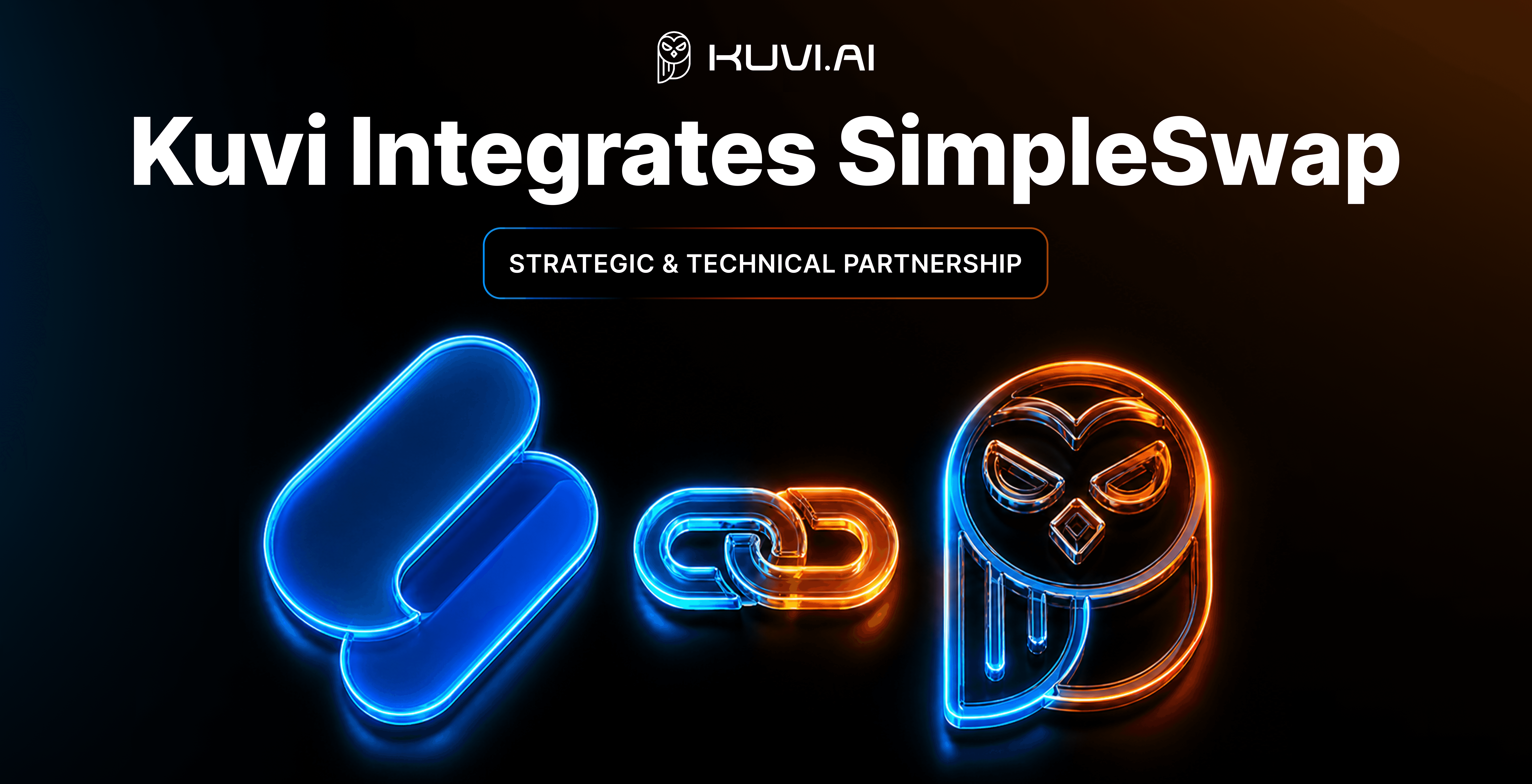
The company’s latest infrastructure expansion through SimpleSwap significantly broadens the range of assets and ecosystems across which Kuvi-powered strategies can operate. By integrating aggregated multi-source execution infrastructure, users can deploy programmable systems that move seamlessly across assets and liquidity environments without being constrained by ecosystem silos.
Kuvi’s leadership in the category will also be showcased at the upcoming Agentic Finance Summit hosted by Microsoft. The company will deliver one of the event’s keynote presentations alongside speakers from organizations including OpenAI and Cloudflare.
Over the past year, Kuvi has expanded aggressively across both crypto infrastructure and AI-powered finance. The company launched its utility token, KUVI, now listed on MEXC and PancakeSwap. It also acquired Altura, a Web3 infrastructure platform, allowing Kuvi to extend its agentic automation technology into gaming economies. On the funding side, Kuvi previously closed a $700,000 seed round and later expanded its strategic round, pushing the company’s valuation from $15 million to $30 million.
About Kuvi
Kuvi is pioneering Agentic Finance. intelligent, intent-driven systems that unify trading, portfolio management, and on-chain automation. Built on the world’s first Agentic Finance Operating System (AFOS), Kuvi empowers users to manage and grow their wealth through natural-language interaction, modular agentic frameworks, and cross-chain execution.
For more information, Read the full press release
Share Blog
Related blogs



Community